Capturing Human Compliance as a Training Signal
Human hands are compliant instruments. Capturing what they do, not just where they go, turns a skilled operator into a source of the exact training signal that stiffness-blind robot policies lack. Here is how the capture works in practice.
Every skilled human manipulation is a compliance demonstration. The compliance is not annotated by the operator. It is enacted by their hand. Capturing the demonstration in a way that preserves that enactment is what makes a wearable-capture dataset actually useful for teaching a robot to be compliant, as opposed to teaching a robot to follow the operator's path.
This piece walks through how BLO LAB captures compliance from human demonstration, what the resulting signal looks like, and what a downstream training pipeline actually does with it.
What we capture
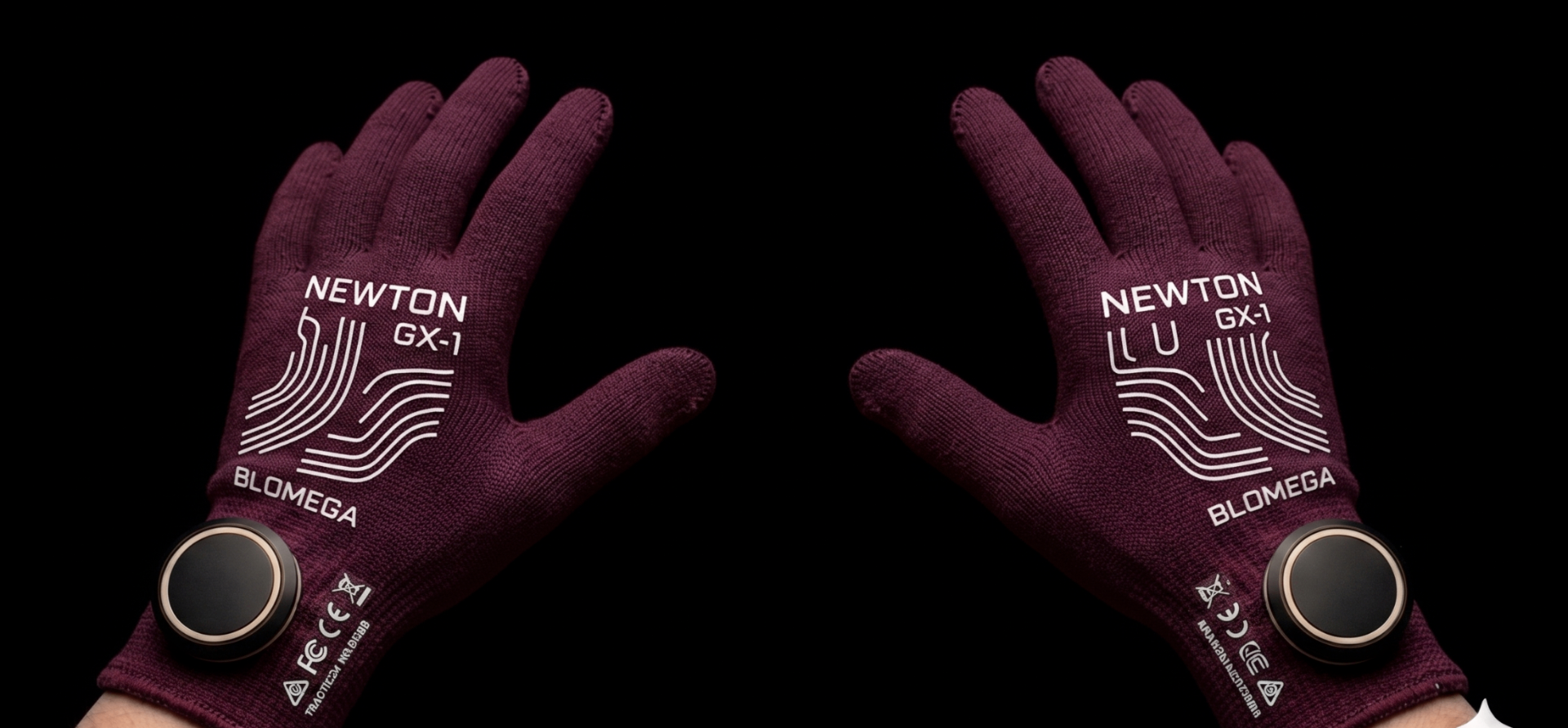
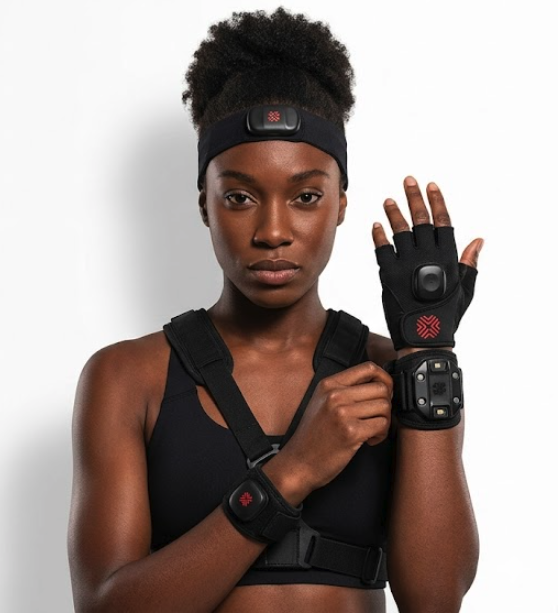
The glove records per-finger force at high rate, palm and volar-side pressure across a coarse array, hand and finger pose from a low-drift inertial-plus-flex stack, and, crucially, the temporal alignment between all three. The suit, when worn, adds whole-body pose and shoulder or wrist force information that lets us reconstruct the mechanical loop the hand is closing against. First-person video from the operator's headband anchors the physical signals in visual context.
The point of this instrument set is not that any one channel is unique. It is that all of them are synchronized and calibrated. Compliance is a relationship between force and motion; capturing it requires that both sides of the relationship be recorded with a common time base and physical units. Pose in millimeters at one hundred and twenty hertz, force in newtons at three hundred hertz, aligned to sub-millisecond precision.
How compliance is recovered from the raw streams
Effective stiffness at each fingertip is inferred from the recorded relationship between applied force and observed motion, evaluated in the frequency bands where compliant behavior actually happens. The inference is not perfect, human hands are nonlinear and have velocity-dependent damping that a linear model captures only approximately, but it is good enough to give a downstream policy a target compliance profile at each timestep.
The recovered stiffness plus the raw force and pose streams together constitute a compliance-labeled trajectory. It is longer, thicker, and more physically informative than a pose-only trajectory of the same task. And it is producible by any operator wearing the standard capture hardware, which is what makes it scalable in a way that biomechanics-lab-grade compliance measurement never was.
How training pipelines consume it
The straightforward consumption is as an additional input to the policy. A learned action head that has seen force and stiffness alongside pose learns to specify all three at inference time, provided the underlying controller can execute compliance commands. This is where most of the value shows up in the near term.
A more interesting consumption is as an auxiliary loss. Even for policies deployed on hardware that cannot command stiffness directly, an auxiliary loss that requires the policy to predict the compliance profile of a demonstration teaches it to model contact-driven behavior in a way that improves pose predictions even when compliance is not the output. This is a free lunch to the extent that anything in machine learning ever is.
The third consumption is as a filter. Compliance-labeled data lets a curation pipeline distinguish demonstrations where the operator handled the task with appropriate compliance from demonstrations where they did not, and to weight the training mix accordingly. This is important because bad demonstrations are worse than no demonstrations, and 'bad' in a compliance sense is invisible in a pose-only view.
Why humans are the right source for this signal
The alternative source of compliance-labeled data is compliant teleoperation of a robot, and it works, but it inherits the compliance of the robot rather than the compliance of the demonstrator. A skilled human hand is a substantially more capable compliance instrument than any current robot end effector, and the compliance behaviors it exhibits are exactly the ones the field wants robots to learn.
Retargeting human compliance onto a specific robot embodiment introduces its own set of engineering problems. Those problems are tractable, and they are the ones we have chosen to solve, because the alternative, training compliance policies from compliance-poor teleop data, asymptotes at the compliance of the source. A policy cannot be more compliant than the demonstrations that trained it.
This is the specific reason wearable capture from skilled human operators sits at the top of the compliance-data supply chain, and it is what the BLO LAB glove was designed to deliver at the volumes foundation-model training actually requires.
Building or training robots?
We license manipulation datasets and run custom capture programs. Get in touch to see what fits.