
Building a Slip-Labeled Dataset From Real Human Work
How BLO LAB captures, labels, and delivers slip and near-slip events at the scale foundation-model training requires. A concrete look at the collection protocol, the physics-based labeling, and what the resulting dataset lets a policy learn.
A slip-labeled dataset is not a slip dataset. It is a demonstration dataset in which slip and near-slip events are surfaced as first-class annotations rather than left as unlabeled frames. The distinction matters because the value to a downstream training run comes from the events being weighted, sliced, and sampled correctly during curriculum construction, not from the underlying data being different in kind.
Building such a dataset at scale requires a specific combination of capture, calibration, and labeling that few pipelines actually deliver. Here is what ours does.
Capture: the events have to be recorded to be labeled
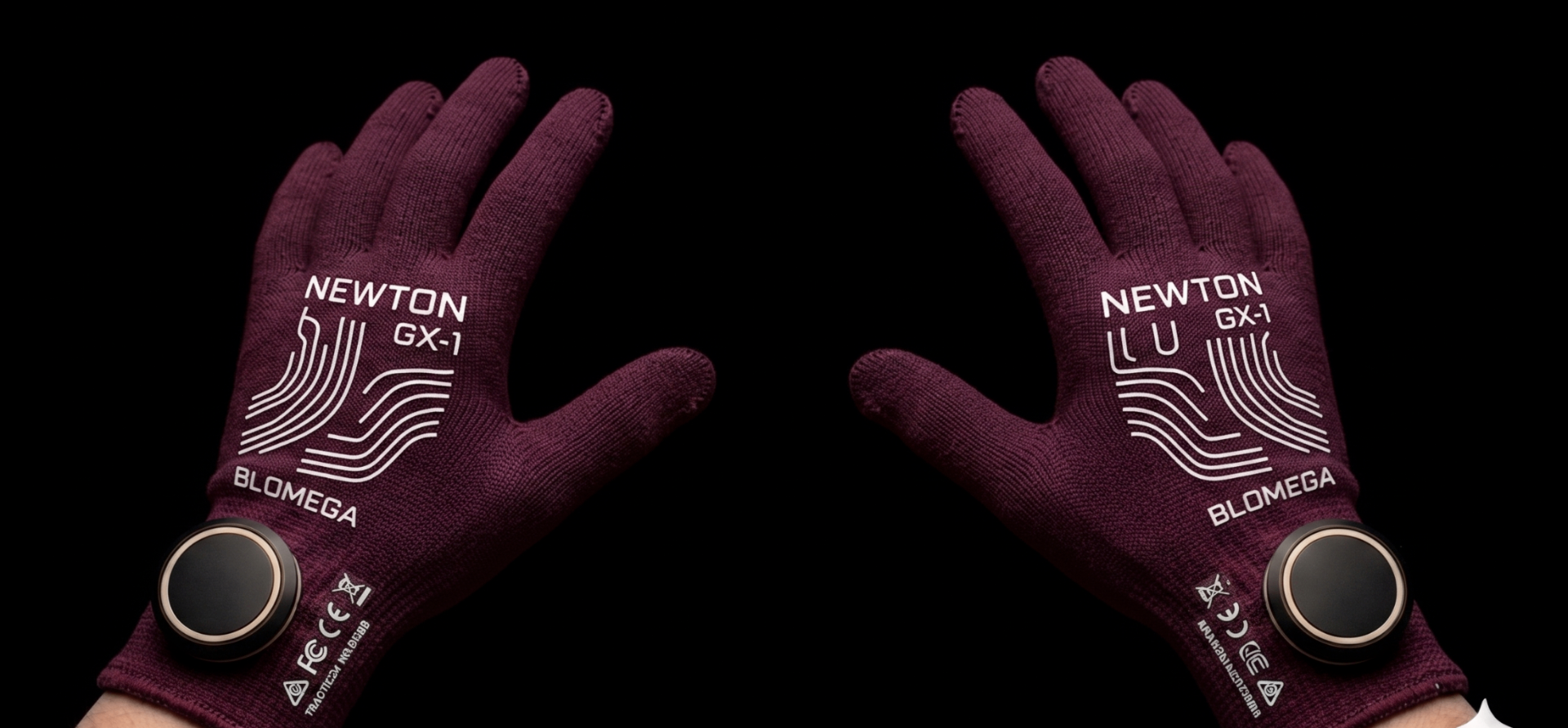
The precondition for slip labeling is that the sensing recorded slip when it happened. On the BLO LAB glove that means fingertip force at rates high enough to resolve incipient slip transients, plus synchronized pose and first-person video so that any labeled event can be traced back to the operator's action and the visual context in which it occurred.
Operators wear the glove and work through a task library that includes fragile objects, slippery surfaces, and manipulation sequences long enough to include natural micro-slips. We do not induce slip artificially. We select tasks in which slip and near-slip are ordinary and let the physics speak.
Labeling: physics first, then annotation
The primary labels come from the force signal itself. A slip detector trained on carefully hand-annotated seed data runs across the full corpus and marks every frame that meets the physical definition of incipient or gross slip. The output is a per-frame binary plus a confidence, plus a short surrounding window that captures the correction if there was one.
Human annotation is a second pass, not a first. Annotators review high-confidence events for quality control, resolve ambiguous cases, and add semantic context, was this a slip that led to a drop, a slip that was corrected, a slip during a handover, a slip during placement. The human pass keeps the label taxonomy honest; the physics pass gives the labels their scale.
This division of labor is the only reason the labeling operation is tractable. Annotating a million trajectories by hand for a subtle sub-second event is not something any pipeline can do reliably. Annotating a million trajectories that have already been sliced by physics into ten thousand candidate events is straightforward.
Delivery: sampling and metadata for training
The dataset ships with slip events promoted into the metadata layer so that a training curriculum can weight, slice, or resample them without touching the underlying tensors. A team that wants to run a slip-heavy curriculum can do so with a one-line dataloader change. A team that wants slip events used only for an auxiliary loss can leave the sampling untouched and read the labels through a separate head.
Every event carries provenance: the operator identifier hashed for privacy, the task and session tags, the sensor firmware version and calibration lineage, and whether the event was corrected or dropped. The provenance is not decoration. It is what makes the dataset auditable, and audits are the shape of quality control that customers increasingly ask for as regulatory and internal-safety-case pressure grows.
What a policy trained on this actually gains
The observable improvement is on the deployment failure category that dominates real fleets. Post-grasp loss rates on unfamiliar or fragile objects drop measurably when a policy is trained with slip events promoted in the curriculum, and the improvement compounds when the policy's action head is conditioned on the force stream so that the learned corrections can actually be executed at inference time.
The less observable improvement is in how the policy handles adjacent categories. Handovers get more robust because the policy has learned what a partial-slip during transfer looks like. Delicate placement gets more careful because the policy has learned the force signature of a soft object about to yield. These downstream benefits are the reason a slip-labeled corpus is worth building even for customers who did not ask for slip specifically.
Why we ship this by default
We ship slip labels on every manipulation dataset because the marginal cost of doing so is small once the physics-first pipeline exists, and the marginal value is large across almost every downstream use case. It is one of the concrete ways the BLO LAB corpus is structurally different from datasets that were built to demo well rather than to deploy well.
The underlying discipline generalizes. Any physically-defined event that a well-instrumented capture rig can detect can be promoted into the same kind of first-class annotation layer. Slip is the first and most obviously valuable. Contact onset, re-grip, and object handoff are the next ones already in the pipeline.
Building or training robots?
We license manipulation datasets and run custom capture programs. Get in touch to see what fits.