
What Is Teleoperation Data and Why Robotics Needs It
A plain-English introduction to teleoperation, how it produces training data, and why every serious robotics team is investing in it.
Teleoperation is the practice of a human controlling a robot in real time, usually to perform a task the robot cannot yet do on its own. In its most literal form, an operator wears a set of controllers, sees through the robot's cameras, and moves the robot's arms as if they were an extension of their own body. In a broader sense, the sense that matters for machine learning, teleoperation is any setup in which a human's intent is captured with enough fidelity that a robot can later reproduce it.
Over the past three years teleoperation has quietly become one of the most important sources of training data in the field. Every joint angle, every gripper close-and-open, every subtle wrist rotation recorded during a teleop session becomes a demonstration a learning algorithm can imitate. The frontier labs training vision-language-action models, Physical Intelligence, Figure, 1X, Google DeepMind, Toyota Research, all spend a large fraction of their budgets on teleop data collection. This is not incidental. It is structural.
The reason is simple: machine learning needs examples, and manipulation examples are extraordinarily hard to synthesize. A human wiping a counter, folding a shirt, or peeling a potato exhibits thousands of micro-adjustments that vision alone cannot infer. Teleop captures those adjustments directly at the actuator level, in the reference frame the robot actually acts in.
Why not just record video?
This is the first question every team asks, and the answer decides how their next two years go. Video shows what happened, not how. Two frames of a hand grasping a mug may look identical while the underlying grip force, contact geometry, and joint velocity differ by a factor of three. A robot trained on video alone learns to look correct rather than act correct.
There is a second, subtler problem. Video is a third-person account of an action. The policy has to invert perspective, guess intent, and infer the action from its consequences. Teleoperation records the action directly. There is no inference step. The trajectory the human executed is the trajectory the robot will try to reproduce.
The frontier labs know this. The largest published imitation-learning datasets, RT-1, RT-2, Open X-Embodiment, Bridge, are all teleoperation-based, not video-based. Video is a valuable auxiliary signal for pretraining perception encoders. It is not a substitute for action data.
The three flavors of teleoperation
Not all teleop is the same, and the distinctions matter for what you can train. The first flavor is direct joint teleop: a leader arm identical to the follower drives it one-to-one. This is what ALOHA popularized. It produces very clean data and is limited to the specific embodiment of the leader.
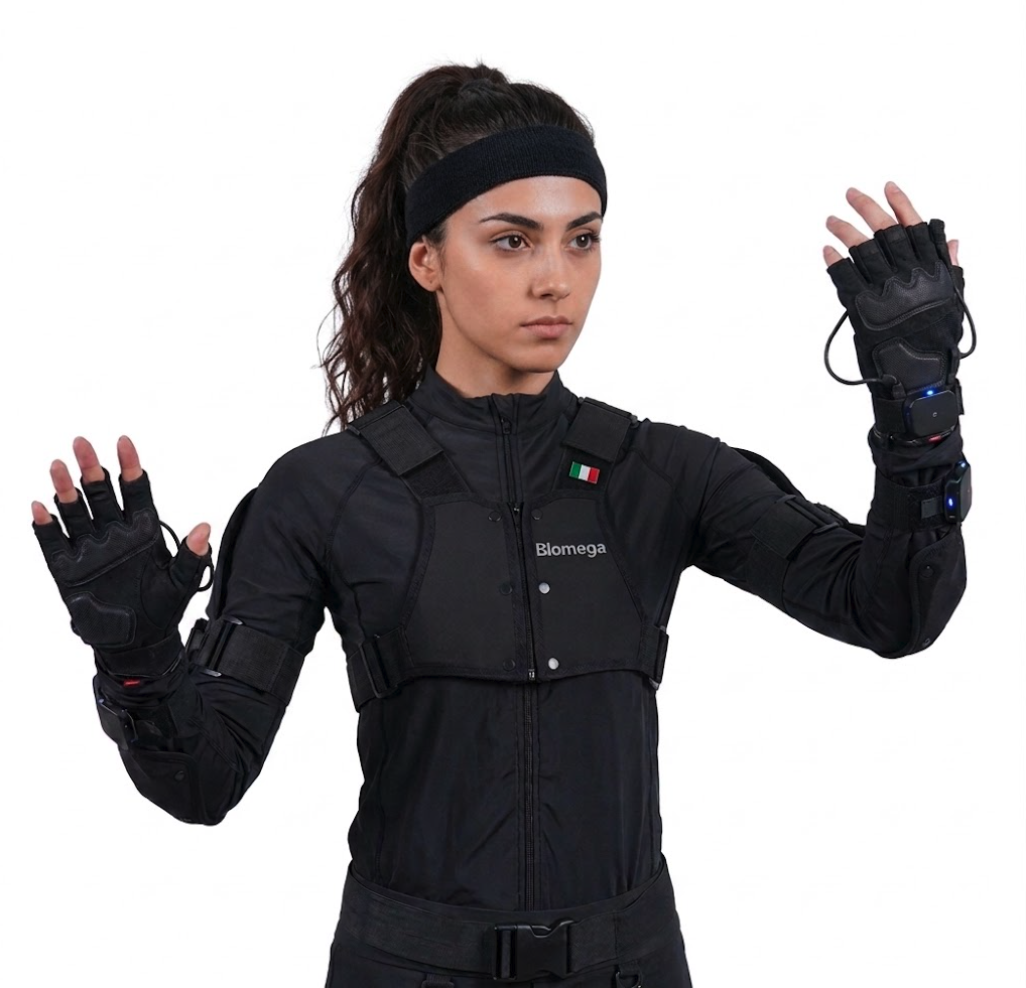
The second flavor is retargeted teleop: the operator's motion is captured with gloves or a mocap suit and mapped onto the robot's kinematics in software. This decouples the operator from a specific robot, so one operator can generate data for many embodiments. Retargeting quality matters enormously here; a sloppy retarget produces a sloppy policy.
The third flavor, and the one wearable capture unlocks, is embodiment-free demonstration: the human performs the task with their own hands, wearing sensors, without any robot in the loop. The recorded trajectory is later mapped to whatever embodiment the customer needs. This is the fastest way to collect at scale, and it is the model BLO LAB is built around.
Where teleop data goes
Behavior cloning, diffusion policies, action-chunking transformers, and vision-language-action models all consume teleop-style trajectories. Even reinforcement learning benefits: teleop demonstrations bootstrap exploration, provide shaping rewards, and dramatically reduce the number of trials needed to converge. In practice, no serious manipulation policy today is trained from scratch without some seed of human demonstration.
The larger the model, the hungrier it is. Diffusion policies converge with a few hundred trajectories per task. Action-chunking transformers want a few thousand. Foundation-scale VLA models want hundreds of thousands per task family. This scaling curve is why the cost per demonstration has become one of the industry's most important numbers.
The economics that follow
Once you accept that teleop data is the substrate, everything else in a robotics roadmap flows from it. How many operators can you recruit? How many hours per week can they capture cleanly? What is the cost per usable trajectory after quality review? These questions determine how quickly a policy improves.
Teams that build their own capture stack learn this the hard way. Teams that partner with a specialized data provider skip the hardest six months. Either way, the math is the same: a good policy is a large pile of good trajectories, and the pile has to grow every week.
The takeaway
If you are building a general-purpose robot, teleoperation data is not optional. It is the substrate. Vision pretraining, sim-to-real, language grounding, reinforcement learning, all of them assume a base of real demonstrations to anchor the model in physical reality. The teams that will ship first are the ones that solved data collection first, and they solved it by treating it as a first-class engineering problem rather than an afterthought.
Building or training robots?
We license manipulation datasets and run custom capture programs. Get in touch to see what fits.