Motion Capture vs. Vision-Only Learning: A Practical Guide
Cameras are cheap, but they miss the physics. Here is when to reach for motion capture and when video is enough.
Every robotics team faces the same early decision: how do we capture demonstrations? The cheapest answer is a phone camera. The most expensive is a full optical motion-capture stage with Vicon rigs and a controlled lighting environment. Between those two poles sits a spectrum of options, wrist cameras, depth sensors, wearable IMU suits, haptic gloves, hybrid rigs, that gets confusing quickly. This article is a practical guide to picking the right instrument for the job.
The wrong choice is expensive in both directions. Overbuild and you burn six months integrating sensors you did not need. Underbuild and you spend a year training policies that never quite work because the ground truth is missing.
What vision does well
RGB cameras excel at scene understanding, object recognition, and generating pretraining data for large vision-language models. A modern encoder like DINOv2 or SigLIP can turn a raw video stream into a rich embedding that captures object identity, pose, and coarse spatial relationships. For tasks where the challenge is knowing what to do, 'find the red cup', vision is often enough.
Vision is also cheap. A GoPro on the operator's head plus a wrist-mounted camera on the robot gives you a usable pipeline for a few hundred dollars. When the goal is scaling to millions of hours of ambient footage, as with Ego4D or Epic-Kitchens, vision is the only economically viable option. Frontier labs use these datasets as pretraining fuel and it works.
Where vision fails
The failure modes cluster in three areas: occlusion, high-frequency motion, and force. Occlusion is the most obvious. The moment a hand wraps around an object, the fingertips disappear from view. Any policy that depends on inferring finger pose from pixels will be guessing during the exact fraction of the trajectory that matters, the contact phase.
High-frequency motion is subtler. Cameras run at 30 or 60 Hz. Human corrections during contact happen at 100–200 Hz. A regripping motion on a slippery bowl, a small pressure adjustment on dough, a wrist twist to align a screwdriver, all of these compress into one or two blurred frames the model cannot resolve.
Force is absent entirely. Two images can be pixel-identical while the underlying grip force differs by an order of magnitude. A policy trained only on video cannot know when it is squeezing too hard because that information was never in the training set.
What motion capture adds
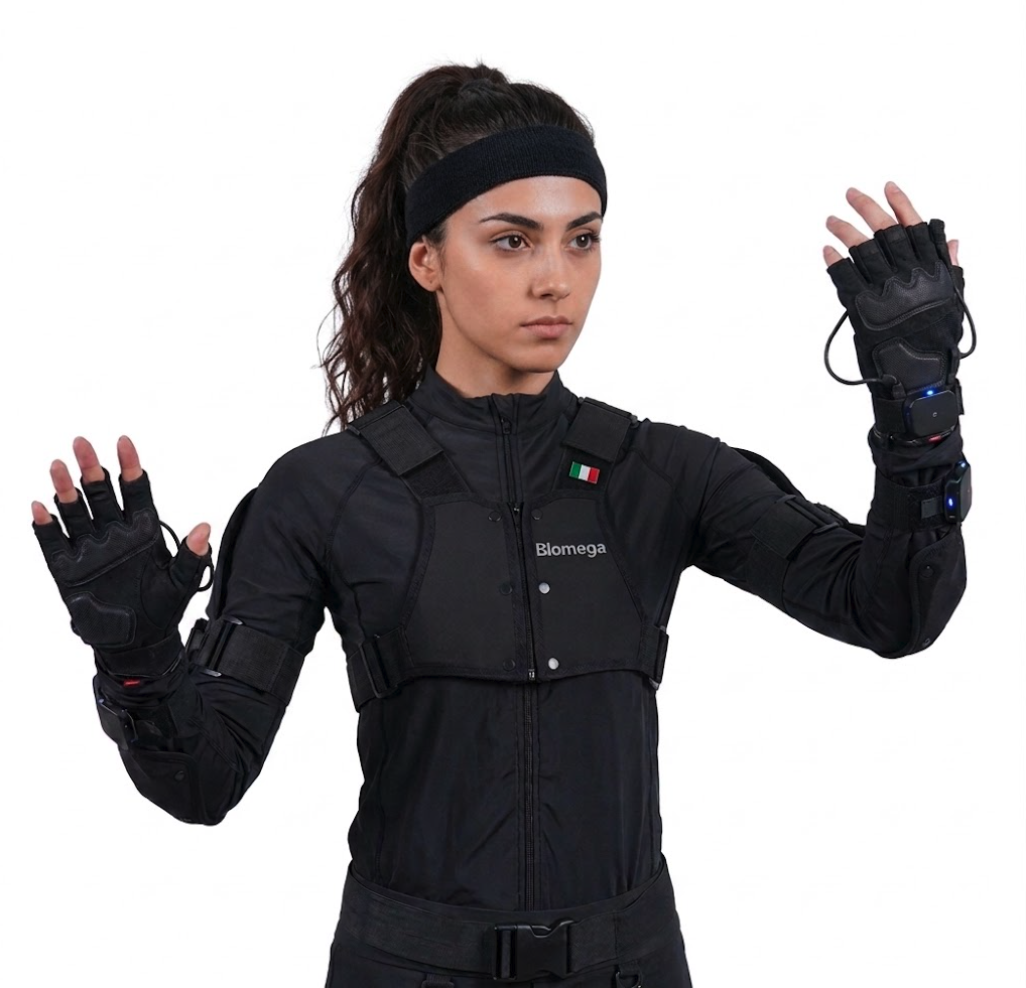
Motion capture, whether optical or wearable, restores the ground truth vision is missing. A wearable suit reports every joint angle at 200 Hz with sub-degree resolution. A haptic glove reports normal and shear force at each fingertip. IMUs measure acceleration and orientation independently of any camera line-of-sight. Together they give a policy the physical variables it needs to reason about the task instead of guessing from pixels.
The other advantage is location independence. Optical mocap requires a controlled studio. Wearable mocap works in a kitchen, on a workshop floor, in a hotel room. That freedom matters, because the point of building manipulation policies is that they generalize to real environments, and real environments are the only place you can capture the messiness they contain.
The pragmatic stack
For most teams, the answer is both. Video for scene context and pretraining, wearable capture for the action signal at capture time, and a training pipeline that fuses them into a single time-aligned trajectory. That fusion is where policy quality is won or lost.
A concrete recipe that works: an egocentric camera on the operator's head, a wrist camera on the manipulated arm (or on the robot at deployment), a full-body IMU suit for whole-body coordination, and a haptic glove for the manipulation-critical hand. Clocks locked to within a millisecond. Data written in a schema that supports selective loading so downstream teams can pull just the streams their model needs.
When you can skip mocap
Not every project needs it. If your task is pure top-down pick-and-place with a parallel-jaw gripper, vision plus proprioception from the robot itself is often sufficient. If you are pretraining a foundation model on internet-scale video, mocap is not going to be your bottleneck. The rule of thumb: mocap is worth the investment as soon as force, occlusion, or high-frequency correction become part of the task.
The decision, made once
Sensor choice is one of those decisions that compounds. Change it a year in and you have to recapture everything. Get it right at the start and every subsequent hire, every fine-tune, every new task builds on the same foundation. Spend a week talking to the teams who have already made the mistake before you make yours.
Building or training robots?
We license manipulation datasets and run custom capture programs. Get in touch to see what fits.