
Why Force Data Is the Missing Ingredient in Robot Manipulation
Robots that only see fail at soft objects, deformables, and anything requiring subtle grip. Force data solves that.
Ask a robot to pick up an egg. If it only has vision, it must guess how hard to squeeze. Guess too little, the egg slips. Guess too much, the egg cracks. Humans do not guess. We feel. The transition from a slipping grip to a secure grip is a haptic event, resolved through the fingertips and the tendons in the palm in tens of milliseconds. No camera watching the outside of the hand can see it.
This is the single largest reason state-of-the-art manipulation policies still struggle with soft, deformable, or fragile objects. The training data is missing the variable the human was actually controlling.
Force as a first-class signal
Every gram of pressure carries information about material, contact geometry, and task progress. Kneading dough is essentially a force-control task with a visual cue: the operator's eyes only confirm what the palms are already deciding. Folding a shirt requires zero force through the middle of the trajectory and precise force at the crease. Wiping a counter is a controlled pressure sweep with velocity constraints. In each case, force is not a side effect; it is the control variable.
When training data includes force, the resulting policy generalizes to objects it has never seen because it learned the underlying physics rather than a visual shortcut. This is why a force-trained gripper can transfer from apples to peaches to plums with no additional data, while a vision-only gripper trained on apples fails on plums it has never met.
The evidence
Recent papers have started to quantify the gap. Adding wrist-mounted force-torque sensing to a diffusion policy has been shown to improve success rates on contact-rich tasks by 20 to 40 percentage points, depending on the task's compliance requirements. Adding per-finger tactile sensing pushes the improvement higher still on genuinely deformable objects like cloth and food.
The pattern holds across architectures. Behavior cloning, diffusion, and action-chunking all benefit. The signal is complementary to vision, not redundant. Fusing force with RGB at the encoder level produces the largest gains.
What we record
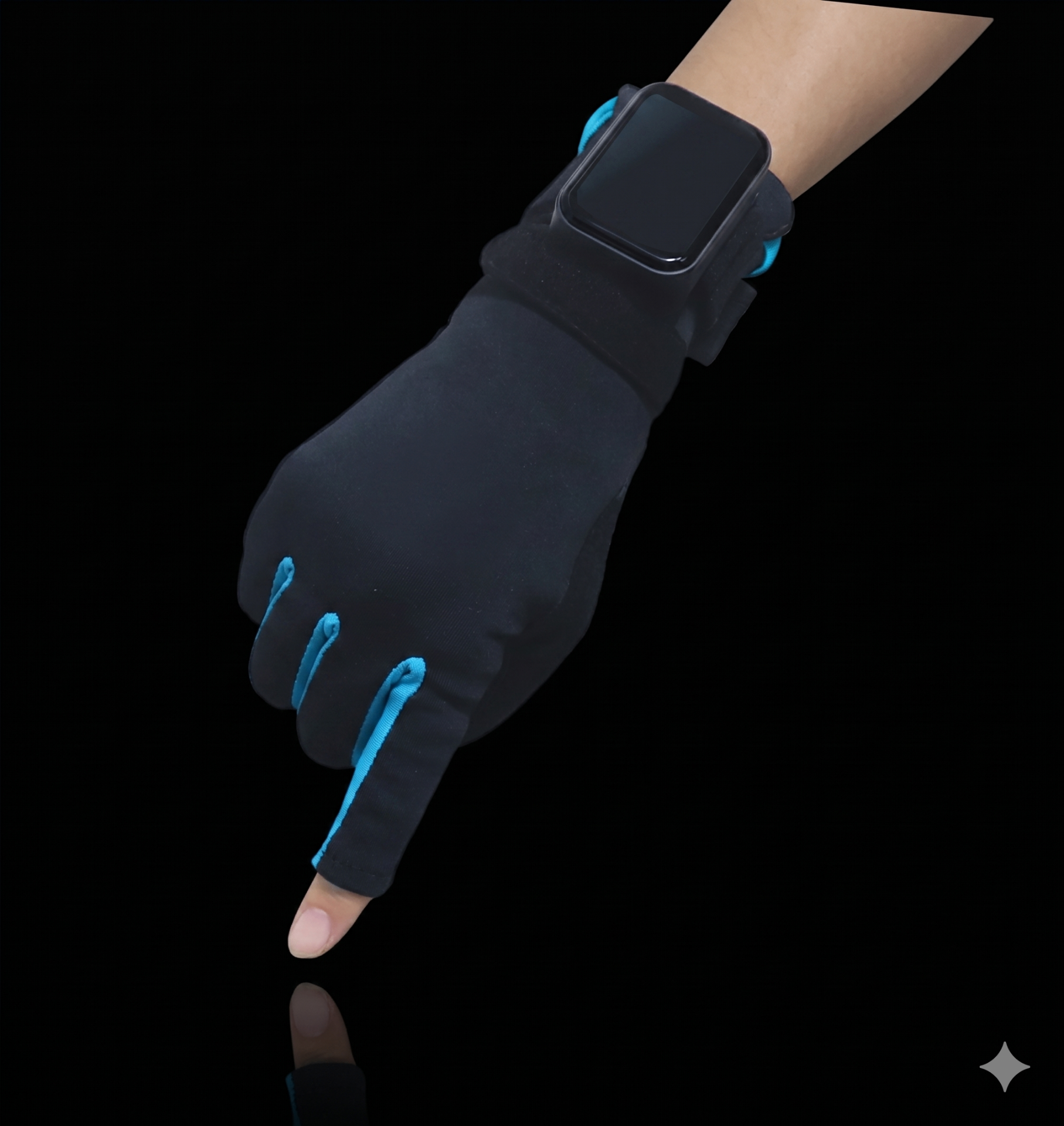
The GX-1 glove reports fingertip force on thumb, index, and middle from capacitive pressure pads, 10 bend channels across the fingers (2 joints × 5 fingers), and a 6-axis wrist IMU, all sampled at 100 Hz, hardware-synced. A full-body suit is on the roadmap; when it lands, the same trajectory extends into whole-body kinematics. Until then, the glove alone carries the scarce signal, force, that no camera can reconstruct.
The output format is intentionally embodiment-free. A trajectory recorded in glove space can be retargeted to any robot hand at training time, parallel jaw, three-finger, five-finger anthropomorphic. This is what makes a single capture campaign useful to teams building on completely different hardware.
The overlooked failure mode
Even teams that add force sensing often make a subtle mistake: they treat force as an observation and not as a target. A better formulation is that the policy should predict force alongside position, and the low-level controller should track both. This closes the loop at the physical level where it belongs, instead of leaving the policy to guess from indirect signals whether its grip is holding.
The takeaway
Vision tells the policy where. Proprioception tells it how much it has moved. Force tells it what is actually happening at the contact. Without force, the model is reasoning about physics with one hand tied behind its back. Every serious manipulation dataset going forward will include force as a primary channel.
Building or training robots?
We license manipulation datasets and run custom capture programs. Get in touch to see what fits.