The Case for Egocentric Video in Foundation Models for Robotics
First-person video captures intent and attention in a way third-person cameras never will.
The head is a natural gimbal. Where a person looks is where a person is about to act. This makes egocentric (first-person) video uniquely valuable for training robots, and it explains why datasets like Ego4D, Epic-Kitchens, and Ego-Exo4D have quietly become foundational to the field.
Attention comes for free
Third-person video shows the entire scene equally. The model has to guess what matters in a frame full of distractions. Egocentric video centers the action, giving the model an attention prior straight from the operator. The gaze bias built into human head motion turns out to be an excellent proxy for task-relevant object identification.
This is not a small effect. Vision transformers trained on egocentric footage show measurable improvements on downstream manipulation benchmarks compared to identical models trained on third-person footage of the same tasks. The attention signal is a form of implicit supervision that no explicit label can easily replace.
Perspective matches deployment
A humanoid robot deployed in a home will see the world from roughly a human height and orientation. An egocentric training corpus already sits in that frame of reference. There is no perspective shift for the model to learn. This narrows the distribution the policy has to generalize over and produces stronger results per training example.
Wrist cameras on the robot serve a related purpose during the manipulation phase, when the head-mounted view is often blocked by the operator's own hands. Fusing head-view and wrist-view is a common pattern in recent VLA models.
Pairing with capture
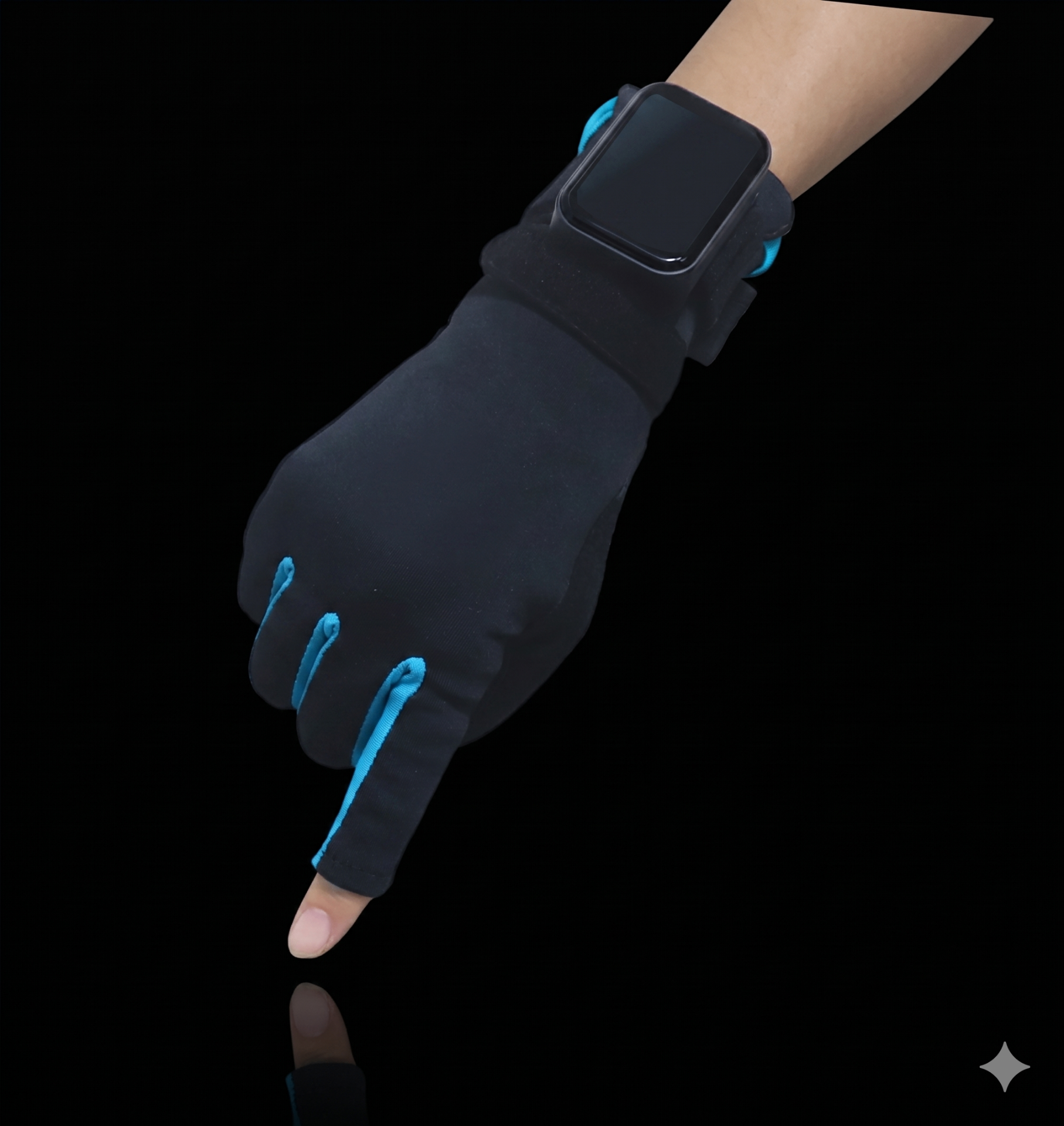
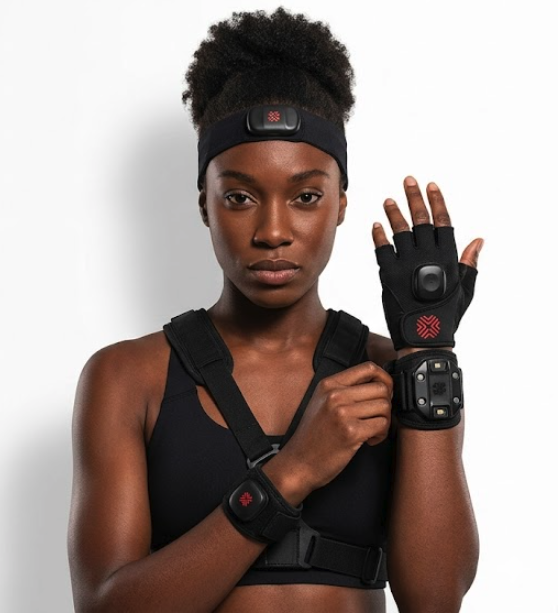
Our headband module records POV video synchronized with the GX-1 glove (and, on the roadmap, a full-body suit). The result is a trajectory a policy can consume end-to-end: what the operator saw, what the operator did, what the operator felt. This tri-modal alignment, vision, kinematics, force, is what makes a trajectory a training example instead of a video clip.
Limitations
Egocentric video is not a total substitute for third-person. Some tasks (whole-body coordination, spatial navigation in cluttered spaces) benefit from an external view for reasoning about the body's relationship to the environment. The pragmatic answer is again 'both, fused.'
Head motion also introduces its own noise. A jerky head shake between two tasks can add motion blur that hurts perception models. Stabilization at capture time (through mechanical damping in the headband) or post-hoc (through IMU-guided rolling-shutter compensation) is worth doing.
The bet
The next generation of robot foundation models will be trained on egocentric video at internet scale, fine-tuned on aligned kinematic and force data at capture scale, and deployed on hardware whose primary viewpoint sits inside the human perspective distribution. Every part of that stack is easier when the training data starts in the same frame as the deployed hardware.
Building or training robots?
We license manipulation datasets and run custom capture programs. Get in touch to see what fits.